The first time most people play pickleball, someone hands them a paddle and says “you’ll pick it up.” And you will. But a few rules that confuse almost everyone in the first hour, especially the scoring and that strange zone near the net called the kitchen. Here’s a plain explanation so you can walk onto the court already knowing what’s going on.
The Court and the Gear
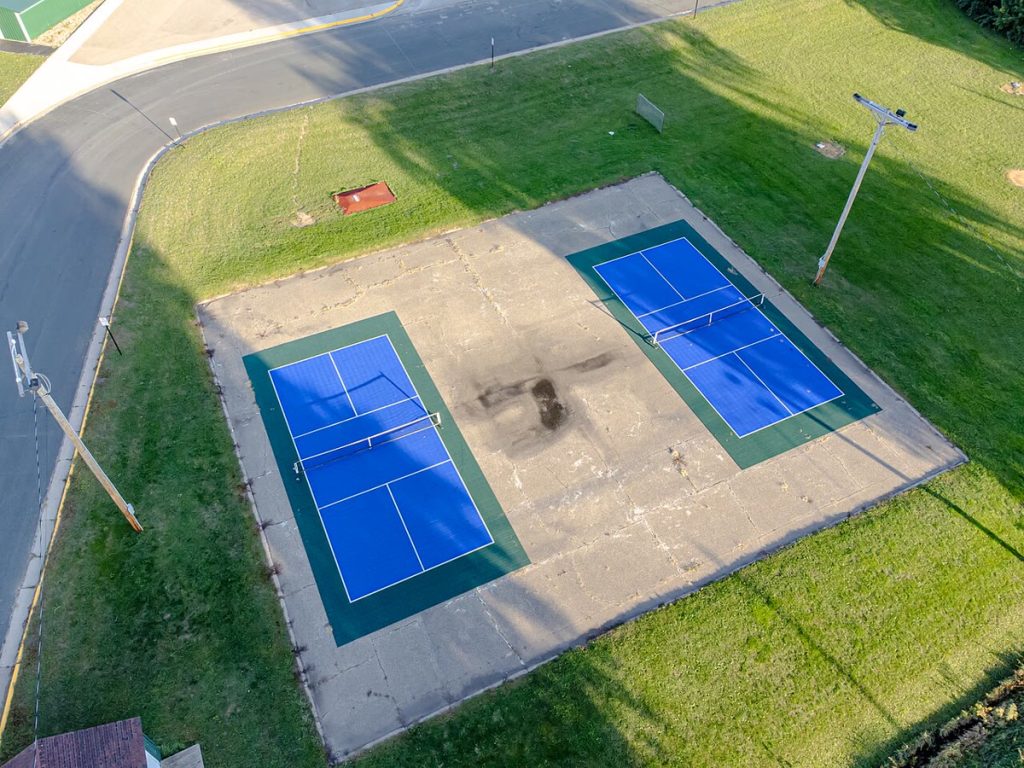
A pickleball court is 20 feet wide and 44 feet long, the same footprint as a badminton doubles court. That’s much smaller than a tennis court, close enough to chat with your opponents between points.
The net is 36 inches high at the sidelines and dips to 34 inches in the middle. On each side, the 7 feet closest to the net is marked off as the non-volley zone. Everyone calls it the kitchen.
You need very little to get started:
- A paddle: solid, flat, and bigger than a table tennis bat. A mid-weight composite paddle is a sensible first buy.
- Balls: plastic with holes. Outdoor balls are harder with smaller holes; indoor balls are softer and lighter.
- Court shoes: running shoes are built for moving forward, not side to side. Tennis or court shoes protect your ankles far better.
How to Serve
The server stands behind the baseline and hits the ball diagonally, crosscourt, into the opposite service box. The serve has to clear the kitchen, and that includes the kitchen line. A serve that lands on the kitchen line is a fault.
For the standard volley serve, three things must be true:
- Your arm moves in an upward arc.
- You contact the ball below your waist.
- The head of the paddle is below your wrist at the moment of contact.
In short, it’s an underhand serve. There’s also a drop serve, where you let the ball fall and bounce before hitting it, and those arm restrictions don’t apply. Many beginners find it easier.
You only get one attempt per serve. Miss it and the serve passes on.
The Two-Bounce Rule
This one rule shapes how the whole game is played. After the serve, the receiving team must let the ball bounce before returning it. Then the serving team must also let the return bounce before hitting it. Once those two bounces have happened, anyone can volley, meaning hit the ball out of the air.
It stops the serving team from charging the net and smashing the return. In practice, the serving team usually stays back for that third shot, while the receiving team moves up toward the net as soon as they’ve hit their return.
The Kitchen Explained
You cannot volley the ball while standing in the kitchen or touching its line. That’s it. You’re allowed to walk into the kitchen whenever you like, and you can hit a ball there after it bounces. What you can’t do is hit it out of the air with any part of you in that zone.
Momentum counts too. If your follow-through after a volley carries your foot into the kitchen, it’s a fault.
This is why you see experienced players trading soft, low shots called dinks that land in the kitchen. The point becomes a patient game of who loses control first.
How Scoring Works
In traditional scoring, only the serving team can win points. Games are usually played to 11, and you need to win by 2.
In doubles, the score is called as three numbers before every serve:
- The serving team’s score
- The receiving team’s score
- Whether this is the first or second server on that team (1 or 2)
So “4-2-1” means the serving team has 4, the opponents have 2, and the first server is serving. Each player on a team gets a turn to serve before the serve goes to the other side. The exception is the very start of the game: only one player on the first serving team serves, which is why games begin with the call “0-0-2.”
When the serving team wins a rally, they score a point and the server switches sides with their partner. When they lose a rally, the serve moves to the partner, or across the net if both have served. That handover is called a side out.
Common faults to watch for
- Hitting the ball out of bounds or into the net
- Volleying before the two bounces have happened
- Volleying from inside the kitchen
- Letting the ball bounce twice on your side
A ball that lands on any line is in, apart from the kitchen line on a serve.
Your First Game Plan
Don’t try to master everything at once. On your first day, focus on getting the serve in, remembering the two bounces, and keeping your toes behind the kitchen line when you volley. Ask the other players to call the score out loud. Most players remember being lost on day one. Give it three or four sessions and the scoring will feel automatic, and that’s usually the point where people get hooked.

Eddy is a professional content writer with over 10 years of experience creating engaging, informative, and reader-focused content across a wide range of topics. Throughout his career, he has developed a strong reputation for producing well-researched, original, and easy-to-understand articles that help readers find the information they need quickly and confidently.